What is Certificado de Vida y Residencia?
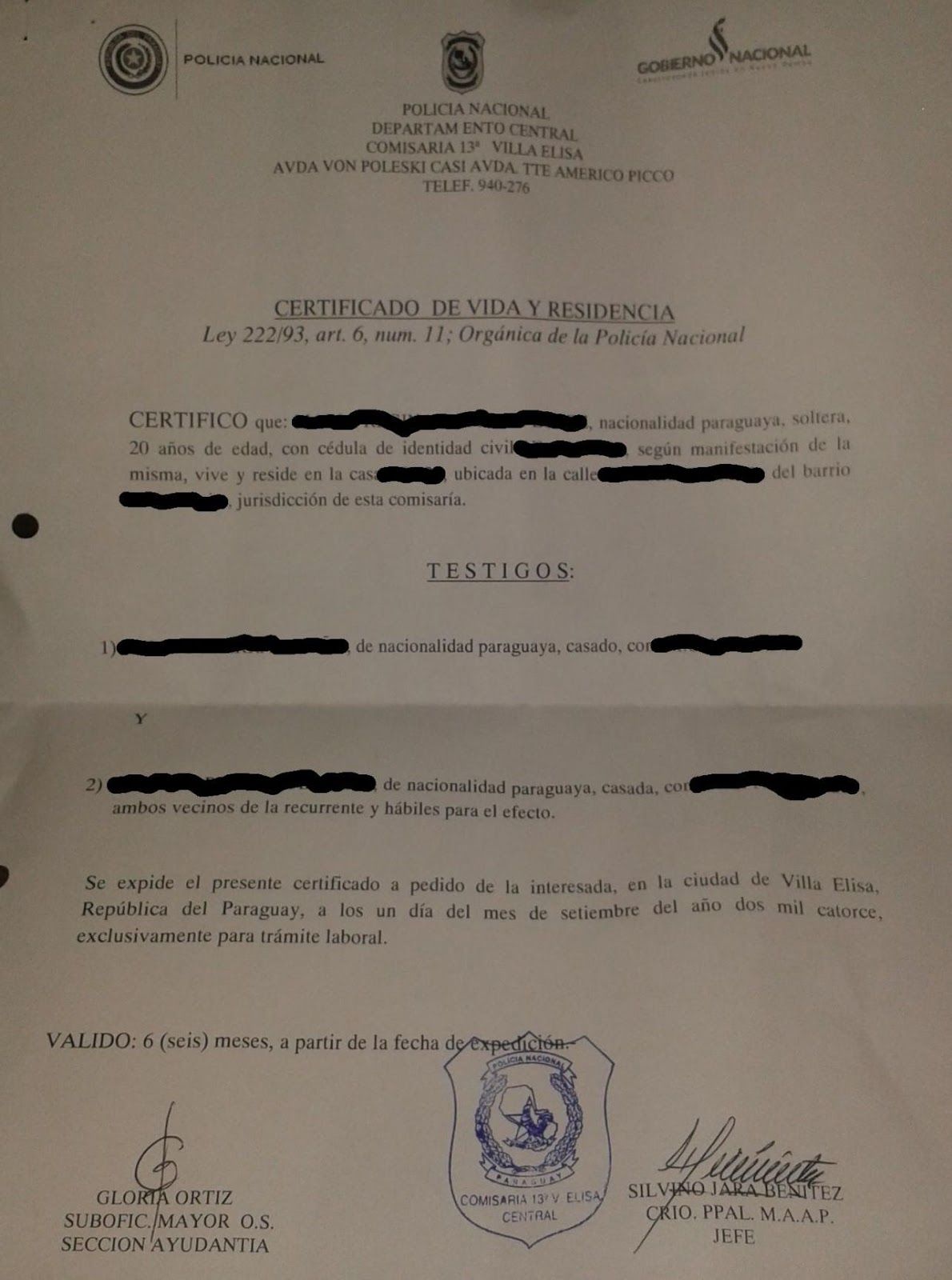
The Certificado de Vida y Residencia (Certificate of Life and Residence) is an official document issued by the Paraguayan National Police that serves two specific legal purposes: it certifies that you are alive (Vida) and validates your physical address in Paraguay (Residencia).
It is a fundamental prerequisite for almost all major immigration and identification processes in Paraguay. While it is not a visa or a residency permit itself, you cannot obtain legal residency or a national ID card (Cédula) without it.
1. What is it?
The certificate is a sworn police document issued by the local police station (Comisaría) that has jurisdiction over specific neighborhood. It is distinct from an immigration card or an ID card.
- "Vida" (Life): It attests that the applicant is a living person physically present before the officer. This functions as a "proof of life," often required for pension/social security purposes to prevent fraud.
- "Residencia" (Residence): It verifies domicilio.
2. What is it good for?
This document is the "key" that unlocks other major bureaucratic doors.
A. Immigration & Legal Residency
This is its most critical use. When applying for Temporary or Permanent Residency, the Migration Office (Migraciones) requires this certificate to prove you are physically in the country. You cannot process your residency papers without it.
B. Obtaining the Paraguayan ID (Cédula)
Once you have your residency, you must apply for a Cédula de Identidad. The National Police Identification Department requires the Certificado de Vida y Residencia.
C. Social Security & Pensions (IPS)
For retirees, this certificate is frequently required by the Instituto de Previsión Social (IPS). It proves the beneficiary is still alive and eligible to continue receiving payments.
3. Misinterpretations
It is crucial to understand the limits of this document to avoid legal confusion.
- It is NOT a Residency Permit: Possessing this certificate does not mean you have legal status in Paraguay. It simply proves you are alive. You can be an irregular tourist and still obtain this certificate; having it does not legalize your immigration status.
- It is NOT a Travel Document: You cannot use it to cross borders or as a substitute for a Passport or Cédula.
- It is NOT a valid ID: It acts as a supporting document, not a primary identification document.
- It is NOT Universal: You cannot use a certificate issued in Asunción for a procedure in Encarnación. It is strictly tied to the jurisdiction of the police station that issued it.
- It does NOT last forever: (usually 3 months depending on a department). You must request a new one for every new major procedure. Do not think this document will last forever. Needs to be renewed often if needed.
- It does NOT prove your tax residence: Expats often think that it can solve all their problems and can be used for proving tax residence internationally. That is incorrect. The Certificado de Vida y Residencia and the Certificado de Residencia Fiscal are two entirely separate documents with completely different legal purposes. They are often confused because both contain the word "residencia," but they serve opposite functions.
- No international use without apostille: For any international use, the Certificado de Vida y Residencia MUST be apostilled. Any document issued by government must be apostilled to be able to use it in foreign country. Document itself won't do the job without proper higher verification.
- Low international validity: The police certificate is a local administrative document. Its international usability and validity is very low, even with apostille. It is a local document and often times over-rated internationally. The document's main international function is for Paraguayan retirees living abroad.
4. Summary of Requirements to Obtain It
To be of use, the certificate must be obtained correctly. You generally cannot get this online; it requires a physical visit to the police station.