Navigating Bitcoin Inheritance
Bitcoin has become an important asset, and as more people acquire it, it is essential to consider the process of passing it on to heirs. In this article, we explore two main approaches to Bitcoin inheritance: self-custody (cypherpunk style) and self-custody with additional third-party assistance. Each approach comes with its own set of considerations, benefits, and challenges. It is important to mention that all set-ups described in this article are self-custody where you have full control over your bitcoin. I am not describing full custodial solutions as they pose a significant threat to every individual and have more downsides than upsides.
This article is not a step-by-step guide due to various lifestyles and many different aspects that I cannot know. Rather, it is content that should spark interest in thinking through and establishing a viable approach to your bitcoin holdings after your demise.
Due to many different scenarios and the complexity of life, please keep in mind that there might be other viable solutions that I can't see now. I am sharing my thoughts, and any constructive feedback is greatly appreciated.
1. Self-Custody - the Cypherpunk Way
1.1. Setting Up a Self-Custody Plan
To be self-sovereign and not depend on anyone else, you have to have all your bitcoin in self-custody. What does this mean? That you own and maintain your own private keys to your bitcoin UTXOs (unspent transaction output). How to do this? The best practice is to buy a physical wallet. The best thing about physical hardware wallets is that they are not connected to the Internet, and this is the best long-term protection for your keys. There are several ways to do your long-term inheritance, such as single signature wallet, multi-signature wallet, etc. For the sake of simplicity, I will describe the single signature wallet setup, and I think most normal people will be looking for this solution. Secondly, I think anyone who already understands what multisig is is advanced enough and knows what I am trying to describe here.
Note: In the future, I am planning to dedicate an article to multisig set-up and compare differences between single signature Shamir secret shares and multisignature set-up with single seed for each wallet.
My goal is to create a kind of overview and spark some questions in your brain about where you can start and what questions you might want to answer yourself in case of inheritance.
Let's do this!
Creating a Wallet
Get yourself a hardware wallet (please do your own due diligence on what brand of HW wallet you want to purchase). I personally like Trezor hardware wallets for many different reasons. The founders behind Trezor created the first hardware wallet ever and are authors of BIP39 and BIP44. In addition to the Trezor founders being great guys, another great advantage is that the entire Trezor environment is open source as much as possible, which means anyone can verify the code and compile their own program, or even tech-savvy individuals can create their own Trezor device from available documentation. I like this transparency approach. Anyway, do your own investigation of what you like the best and purchase a hardware wallet that you like, that is secure and transparent. There are various brands on the market, and it is fully up to you.
Backup and Recovery
In order to regain access to your bitcoins (if your device is lost/damaged/compromised), you must have a "seed," which is the mnemonic representation of private keys. With access to the seed, you can access your wallet and your bitcoins. When setting up your wallet for the first time, it will generate a new seed for you.
Seed
What is the best practice? I suggest the following: create a Shamir secret share - this is the type of seed where you can split the seed into separate shares, and you can identify how many shares you will need to restore access to your private keys. One example can be 2 out of 3, which means that you will need 2 shares out of 3 to restore access. Very popular is 3 out of 5. Just before setup, think about your own needs and plan the whole share storage setup (where are safe places, how many different safe places you have in your life circle).
Shamir Secret Sharing is a great way to store your seeds. It minimizes a single point of failure. Imagine you only have one seed (12 or 24 words); then you could face a single point of failure such as it getting stolen, you can't find it anymore, a building collapses and you can't find it, etc. That's why it's good to double down on diversification and have more options without compromising security (if one share of itself is stolen/lost, it is not a threat to your setup).
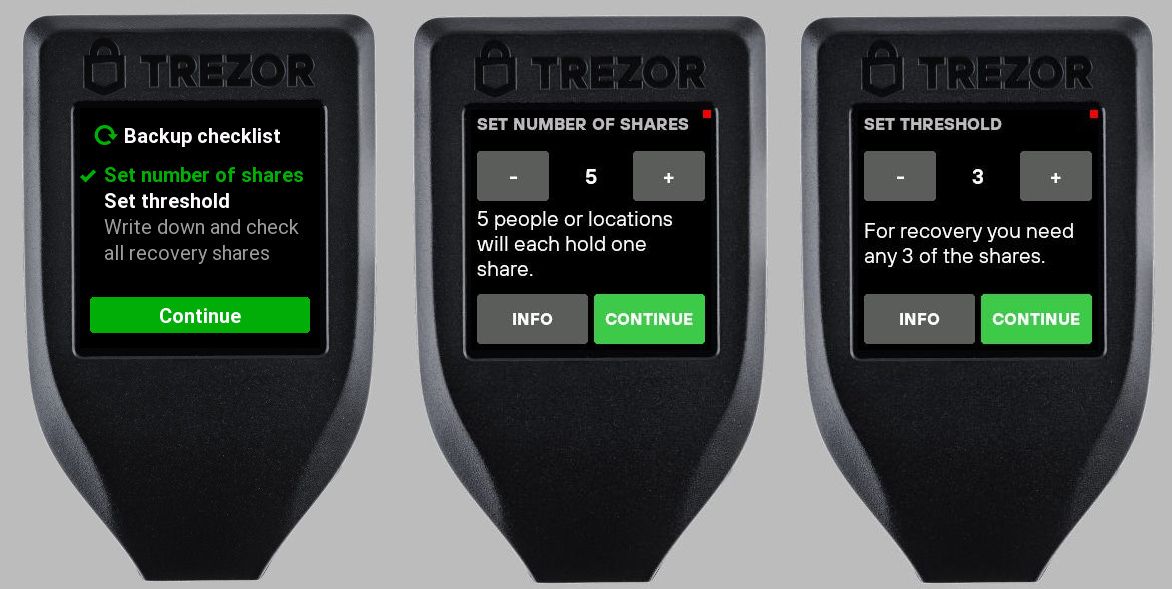
Note: not all hardware wallets support the Shamir Secret Share implementation (SLIP39). If you have decided that your hardware wallet will be one that does not support Shamir secret sharing, then I suggest setting up multisig. This is to eliminate a single point of failure with only 1 seed share.
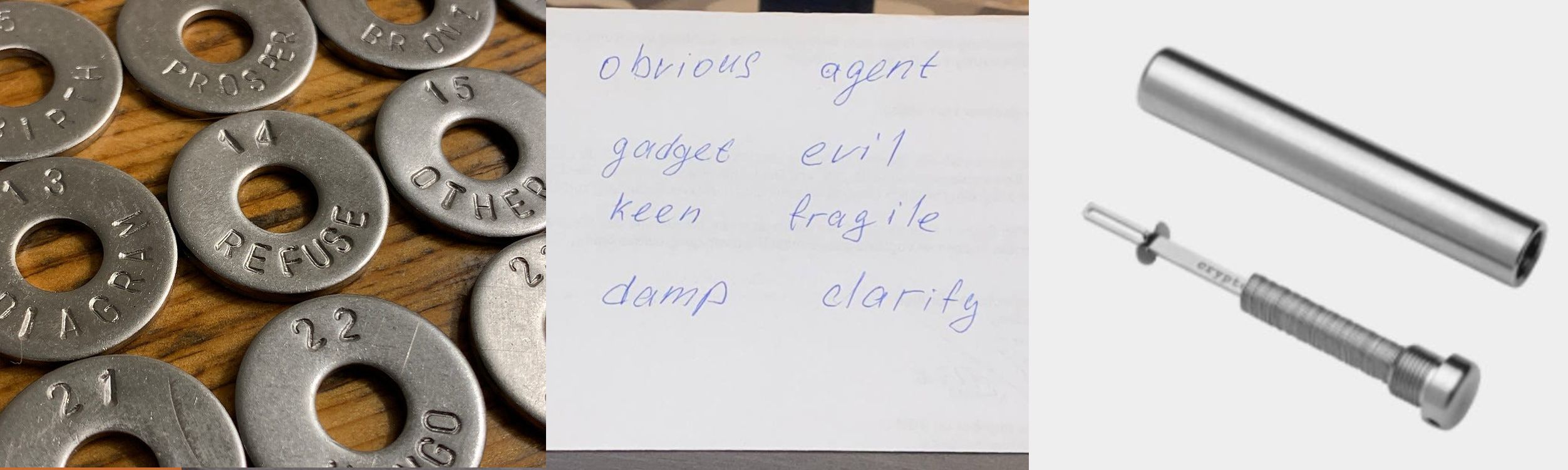
When you have your plan, your hardware wallet, and your seed, the best way to keep them intact for years is to use "metal" solutions instead of paper. There are many commercial options on the market these days, or you can do it yourself from stainless steel washers and stamping die. Here are some tests from Jameson Lopp on metal solutions.
Passphrase
Passphrase is another level of protection. Don't get confused with PIN, passphrase, seed. These are 3 different types of security.
Let me break this down for you:
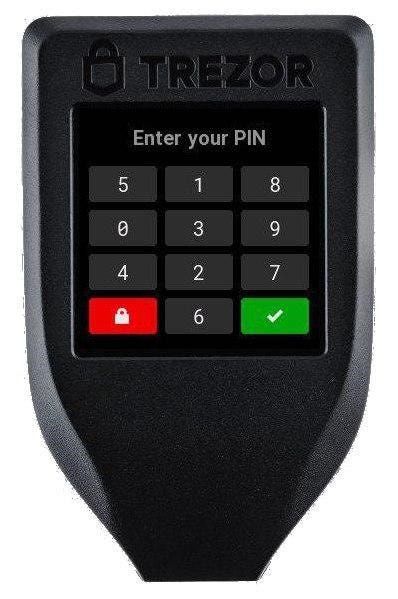
- PIN is a lock on the screen of your physical device. It serves you when you have access to your physical wallet and want to unlock it. It can be overridden with the seed.
- SEED is the mnemonic representation of your private keys. The seed is very important because from these words, you are able to restore the entire bitcoin holding even without a physical device. Do not share it with anyone and store it securely offline.
- PASSPHRASE is an additional word/phrase on top of your seed. Imagine this as the 13th or 25th word (or phrase) that is creating a totally different derivation path to your bitcoins. This means that with the passphrase implemented, you have an extra layer of protection, and even if your seed is compromised, no one will be able to access your bitcoins without this passphrase.
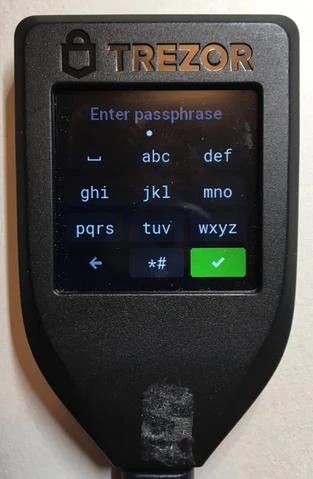
The passphrase should not be kept together with your seed, and secondly, the passphrase should be long to protect you well (you want at least 5-6 words or around 20 or more characters). However, when you lose it, you can't access your bitcoin. So, don't lose it.
Why use a passphrase? It's another layer of security that makes it impossible for someone to access your bitcoin without knowing the passphrase. And if the passphrase is long enough, it can't be brute-forced either.
Wrap up
Select and buy a hardware wallet. Ideally, a fully open source wallet that is brand new. Don't use a hardware wallet from somebody else.
Generate a new seed, ideally Shamir secret shares. It is up to you how many shares have use-ability in your case. NEVER put the seed into a phone, computer, or cloud. You want to have the seed stored offline, ideally on a metal solution. Do it alone, take your time, with no cameras or other distractions. If your wallet does not support Shamir secret sharing, then I suggest setting up multisig (it is a bit more complicated for advanced users and specific use cases).
Test it. Hardware wallets have the function to restore your wallet. Do it before you send any funds there. Test it and try how it works. If there is any error, you want to see it now and not when you really need it.
Create a passphrase that is an additional security layer on top of your seed. Do not store the seed and passphrase together. Keep them separated.
Note: The passphrase is not stored in the device itself and cannot be extracted if you forget it. That is why you should be sure you have your passphrase written somewhere (offline, in a secure place).
Set up a PIN for your device. That is the code you will use in daily/weekly/monthly interaction when you need to receive or send funds. For "daily" use, you do not need the seed. You only need the PIN and passphrase to access bitcoin in your device.
Check your set-up every year. Just to be sure that everything works and that nothing has changed. If you are not using the wallet regularly, then a yearly check is a good practice.
Store your seed shares and passphrase in your pre-selected locations where they are secure enough for you. Each share should have a separate location. That is why it is important to select the right number of shares that you want to have and the right number that you need in case of restoring access. This might be the most time-consuming part—to set this right. Take your time, think it through, and set up your ideal scenario. Very popular options normally are 2 out of 3 and 3 out of 5.
1.2. Securely Passing Down Bitcoin
The setup is ready, everything is in place. You are organized, you know what you are doing, and you are comfortable with the setup. Please be comfortable with what you are doing. We are talking about your inheritance, for which you are totally responsible. If there is a mistake, you are the only person who can fix it; no third party can help you.
Educating Heirs
You should talk to and at least briefly inform your heirs. It can be your spouse, your child—you decide. Even if they don't know much about bitcoin, it is important for them to know that something like this exists. However, don't exactly disclose your "treasure hunt." The more they want to know about bitcoin, the better. Because then, the whole recovery process will be much easier if they already have an idea of how bitcoin works. If not, at least let them know that there might be some treasure hunt in the future, and you are setting everything up to make it smooth for them.
Instructions and Access
I suggest you write a step-by-step guide on how to access the funds when you are in possession of seed shares. This is nothing sensitive, and you are not disclosing any sensitive information. Describe what a wallet is, what a seed is, where to put the seed, what a passphrase is and what it does, etc. Create a guide that allows someone to reconstruct access even without technical knowledge. Make it easy for your heirs. Don't worry, this kind of general guide on how everything works and what to do with the seed and passphrase is readily available on the Internet.

This guide can be kept with other important documents because no sensitive information is included. It's just a guide like for your "washing machine," a very important "washing machine." Just make sure your heir can find it when they need it. If your heirs are advanced bitcoiners, I am sure there's no need for this type of guide.
The second part, totally separate from the first one, should contain some hints on how to look for seed shares and where they can be found. I suggest keeping this document well protected and very safe in physical form. This is the "treasure hunt" part. You decide how to do it. You can give some clues to find another document where there is more information about the seed shares, or you can already give some hints about where the seeds are hidden.
Often, you can use some life situations, places, strong memories you have with the person who should inherit bitcoin... You share those events or memories with your spouse, and they can crack the code. There is no silver bullet for this. You have to use your imagination to convey this crucial information in a way that doesn't make much sense to anyone else who finds it. It's about finding the balance between sharing important location information and not explicitly revealing the location of your seed shares.

Go back to your childhood and have fun inventing the treasure hunt with a grain of significance. Shamir's secret gives you the option to already tell your spouse about one share while keeping all the others hidden. Knowing one share does not compromise security. There are many varieties, so think it through well.
Legal and Tax Implications
No one knows about bitcoin, except your heirs. Neither third parties nor the state. It is difficult to generalize information in this configuration because everything is quite individual. I can't speak for you if I don't know your use case, model, life configuration, etc. Think about whether it's a good or bad idea for no one to know that you or your heirs own bitcoin.
Example scenario: Your bitcoin was purchased no-KYC and will pass to your heirs. No one will know anything. You are totally off the grid. It is not part of the succession procedure; it is not part of your last will. It is just between you and your heirs.

The downside could be if your heirs want to start using bitcoin not in the parallel economy but liquidate bitcoin to FIAT (especially if the amount is significant). In this case, you may have many "eyes" looking at how your heirs obtained the "wealth." This could be accompanied by capital gains taxes. This issue will depend largely on the country jurisdiction in which they have tax residence.
The first thing to ask yourself is what your heirs plan to do with the bitcoin. Are they in the same boat and want to have bitcoin as "insurance against anything and everything bad that can happen"? Furthermore, do they want to spend it in a parallel economy in a P2P way without anyone knowing? If you have answered YES, then this is a perfect set-up for you.
Do your heirs plan to get rid of bitcoin and liquidate it into FIAT at the very moment you die? In this case, this solution above may not be the ideal solution for them.
1.3. Challenges and Risks
Security Concerns
There are no third parties involved. It's all on you. You are fully responsible for the security and ensuring that your heirs can recover it. They should know some basic bitcoin concepts and be aware of the fact that bitcoin exists.
Overall concerns
As already mentioned, this configuration is suitable for you when your family views the world and life with the same values in the cypherpunk way. If your views are different or not aligned, it may not be the ideal approach.
Best Practices
Go through your set-up every year and make sure all works well and is as it is supposed to be.
2. Self-custody with third-party assistance
Another option for inheritance is with the help of third parties. Do not trust them completely, but they will play a certain role in the process. I definitely don't suggest this option without Shamir secret shares or multi-signature wallet in place. Without Shamir or multisig, there would be a single point of failure. Complete custody with a third party is not a smart idea. I would say it is a terrible idea.
2.1. Legal Assistance in Bitcoin Inheritance
The basic principles are similar to those of cypherpunk inheritance. As we have described above, you still want to be sure that there is no single point of failure. That is why we are not going to explain full custodianship with third parties where this single point of failure occurs. Let's start again from the beginning.
You will set up the wallet, seed, and passphrase as in the previous scenario. You want to be in control of your bitcoin. There is no difference at all. Please look at paragraph 1.1 and do the same.
The difference lies in where and how you store the seed shares. Let's take an example of how it might work.
You have Shamir secret shares where you need 2 shares out of 3 to recover your funds. One share may be with your spouse or known to be stored in a specific location. The second share may be hidden elsewhere, and the third share may be with the attorney or in a bank deposit box. In this case, you know that 2 shares are needed to recover the funds, and neither party has access to 2 shares at the same time while you are still alive.
The Role of attorneys/third party
Attorneys can hold one share in custody along with your testament. This will only be executed upon your death. If you do not wish to have a share in the custody of attorneys or legal representatives, you can rent a bank safe deposit box and deposit a share there. Again, the deposit box will only be open to your heirs when you pass away. And the bank, in case something bad happens, can do nothing with only one share available.

Legal Framework
The good thing about this solution is that your testament can be with a legal representative who can describe what will happen after your death.
Another case is to create a testament on your own and store it somewhere without a third party. However, you must make sure that the testament is valid (check what the legal requirements are for a testament to be valid if it is not signed in the presence of an attorney). If you do not use the services of a legal representative for the testament, make sure that your spouse knows about the last will and can find/locate it when necessary. If your family relationships are not good, having a will may be an option to solve it, but again, there are many nuances, and you should first think (or seek help) about what is the best option for your case.
2.2. Legal and tax implications
Tax Considerations
This could be the easiest way to legally pass bitcoin to your heirs so they can easily use bitcoin after your death.
Note: This paragraph cannot be specific because different laws apply in different countries. Do your own due diligence and gather information on inheritance tax, capital gain tax, etc. To be sure you have this right, I suggest consulting this matter with an attorney to advise you on the legal implications for this set-up.
Example: Some countries allow direct inheritance procedures without any withholding tax, and the heirs at the time of receiving the bitcoin have the "purchase" price on the same day they inherited that asset. This means that if they decide to liquidate the bitcoin on the same day, there will be no tax due to the same "buy" and "sell" price. That can have a great tax benefit if they want to sell it.
Disputes
A very difficult subject to analyze. I am not a lawyer, and secondly, there may be different laws in different countries. Just a couple of questions you should try to answer for yourself:
If there is a dispute between heirs, does the testament resolve the dispute?
Is it better to stay without an official last will and pass bitcoin to those you really want to receive it via your own "treasure hunt" structure?
Does a third party solve problems in the family? If there is any problem in the family, can an attorney with your testament address and solve it?
If you are not sure, I think it would be good to consult with an attorney who understands all implications well.
2.3. Benefits and Drawbacks
Pros and Cons
Although having a third party involved in the process simplifies inheritance for ordinary people "without the need for complicated treasure hunts," it can pose some challenges related to disputes within the family. You have to answer this for yourself.
Official inheritance procedures can simplify bitcoin inheritance and generate tax benefits and ease of use for heirs in the future.
One downside: Third parties and the state know that your heirs inherited bitcoin and its value. Your heirs are no longer off the grid if you were before.
Conclusion
Inheriting Bitcoin is a crucial aspect of managing your digital wealth for the future. Whether you choose self-custody or self-custody with third-party knowledge, careful planning and consideration of all relevant factors are essential. Ultimately, the decision should align with your specific circumstances and priorities. By following the guidelines presented in this article, you can start thinking about the seamless transfer of Bitcoin to your heirs.
Take your time to evaluate all pros and cons. Circumstances might change during your life, and you might want to redesign the whole inheritance set-up. That is totally normal and fine. Be sure to re-evaluate your set-up at least every 3 years to ensure it is still valid and works well for your case and life phase.
Note: Try to avoid full custody solutions as I mentioned at the beginning of the article. They carry lots of risks and a single point of failure. You never know what might happen. Bitcoin is an asset that does not need custodians. Its benefit is to be fully responsible for your own wealth without any third-party approval. Use this benefit to your advantage. I understand that custodial solutions might be much simpler to set up for ordinary people, but they bring different threats into the equation. Try to educate yourself and get on the path of self-custody and taking responsibility for your own wealth.
Note 2: One tip: get non-KYC bitcoin. You can always reveal yourself if that is the goal. However, it does not work the other way around. Having no-KYC bitcoin gives you the freedom to decide what to do next. Your heirs can inherit non-KYC bitcoin without third-party involvement, while you always have the option to include it in your last will and go the official route through lawyers. Note that with KYC bitcoin, it is much harder to stay off the grid if that is your wish, especially for your "uneducated" heirs if the issue is not solved upfront.
Disclaimer: I am not a lawyer; research for yourself what legal implications the inheritance may have. I am just trying to give some insight into the problematics. Secondly, I am NOT affiliated with or paid by any products/services mentioned in any way.